Well it is summer, though you wouldn't know it by the temperature. The birch leaves have stiffened up and are now a dark leathery green. The bracken is knee high, and is trying to take over every edge it can making some paths impassable until the winter. I step on the fronds that come up on the paths, but this is not nearly enough to keep them open.
Today I saw two male scorpion flies, but I didn't have my camera or a net, so all I could do was look at them. I must make an effort to catch one and take a photograph for the web site.
Bombus pascuorum workers were busy in the field and woodland edge, but I haven't seen many in the garden, although all the other common bumblebees are out in force. I am so glad to have a lot of Bombus hortorum on my viper's bugloss. it is such a wonderful plant for them, and the flowers go on and on. They will last at least until the lavender is in bloom, so hortorum will have plenty of nectar from my garden all through summer and until it gets colder.
Oh, my timer is pinging at me, that means by bread must be ready, so I'm off.
Showing posts with label bumblebees. Show all posts
Showing posts with label bumblebees. Show all posts
Tuesday, 19 June 2012


Thursday, 17 November 2011
Hoverfly that looks like Bombus pascuorum

This hoverfly was foraging in the woods along with Bombus pascuorum, and at first glance could easily be mistaken for it. I'd seen it many times before, but had never managed to get a good photograph of it. This is the best I could do. However when I got home and tried to identify it I realised I hadn't taken a very good photograph of the vital parts that distinguish this species - it has orange antennae - most other hoverflies have black or dark brown antennae. Anyway at least I've got a photograph of it. I set the camera to zoom and stood well back. Before I was setting it to close up, as I do for bumblebees. Bumblebees are so tolerant and will let you get within a cm before showing any signs of anger.

Monday, 17 October 2011
The Speckled wood, Pararge aegeria
Just added this photograph of a Speckeld wood that I found lying, sunnings itslef on a path in the wood one morning. I tried to take a photograph, but the movement of the leaves prevented it, so I took it home, photographed it and put it back later.
 For the past few days the weather has been really mild, and yesterday I saw 2 Bombus terrestris queens foraging off my lavender and viper's bugloss. These were the first terrestris I'd seen for ages, in fact the only bumblebees I've had in the garden for the past few weeks are pascuorum.
My plants are looking pretty tatty, and i have started cutting back some of the lavender, but I always leave cutting back until there are no flowers at all, so no nectar. I'm glad I did this year as it has really helped the pascuorum, who have had the nectar practically to themselves - although I expect the night-flying moths get their share.
The weather has turned cold and rainy today, and nothing is foraging from the garden flowers, though I did see a few hoverflies early this morning in the woods before the rain hit. Lots of red squirrels in the woods. This appears to have been a bumper year for them.
My log fire was lit, and my desk lamp was switched on at 3:30 this afternoon - it's like winter.

My plants are looking pretty tatty, and i have started cutting back some of the lavender, but I always leave cutting back until there are no flowers at all, so no nectar. I'm glad I did this year as it has really helped the pascuorum, who have had the nectar practically to themselves - although I expect the night-flying moths get their share.
The weather has turned cold and rainy today, and nothing is foraging from the garden flowers, though I did see a few hoverflies early this morning in the woods before the rain hit. Lots of red squirrels in the woods. This appears to have been a bumper year for them.
My log fire was lit, and my desk lamp was switched on at 3:30 this afternoon - it's like winter.
Tuesday, 4 October 2011
Cream spot ladybird
Finally added this little cream spot photograph to the ladybird page.
 I photographed it way back in April. It was on a birch tree in the garden, but had been blown off, so I took the pic and put it back on. Today the leaves from that tree are blowing everywhere - it is a very blustery day. The Bombus pascuorum are still hanging on though - they are the only species of bumblebee left in the garden, but there are still plenty of flowers for them to forage on.
Been given my husband's old HTC phone. It is lovely and does lots of things, but it is a bother to carry around. My old tiny Nokia fitted quite happily into the pocket of my jeans, but this one doesn't, or rather it does, but the touch screen keeps getting touched (squashed more likely) by my jeans, and eventually I get a beeping phone telling me it has little or no battery power left. I have a little pocket thingy that fits on my belt loop, but I don't wear a belt with all of my jeans, and it look silly when I have a long jumper on, so what to do? I don't carry a bag when I go out dog walking, or when I'm in the garden, but I do need my phone for the odd occasion that somebody remembers I exist. Must I get extra baggy jeans? It is getting colder now, so I wear jackets when I go out, so it is not too much of a prob. but what'll I do for next summer?
There must have been at least 4 or 5 days this year when I went to the woods with a short sleeved t-shirt, jeans and non-waterproof shoes - this is called summer up in Scotland - we don't get it every year, and it comes as quite a shock when it happens. My dog has to go into the burn and lie down to cool off when it's hot, actually she has to go into the burn on most days. I've seen her on a day of icy blizzards jump into the burn with icy water swirling around her at belly height, and you can tell she is just loving it - it's the heat that gets to her.
Just started Dawn French's Dear Fatty good so far, and expect it will be all the way through. Also got, at great expense, the New Naturalist's the world of Spiders by Bristowe, oh they don't make them like him any more. I could live, study and write for 100 years and never come close to these guys. Any time somebody complements me on the web site or my knowledge of creepy crawlies, I am aware of just how little I really know compared to them. Oh, well Flossie says it is time to explore the woods for an hour or two to make sure everything is as it should be.

Been given my husband's old HTC phone. It is lovely and does lots of things, but it is a bother to carry around. My old tiny Nokia fitted quite happily into the pocket of my jeans, but this one doesn't, or rather it does, but the touch screen keeps getting touched (squashed more likely) by my jeans, and eventually I get a beeping phone telling me it has little or no battery power left. I have a little pocket thingy that fits on my belt loop, but I don't wear a belt with all of my jeans, and it look silly when I have a long jumper on, so what to do? I don't carry a bag when I go out dog walking, or when I'm in the garden, but I do need my phone for the odd occasion that somebody remembers I exist. Must I get extra baggy jeans? It is getting colder now, so I wear jackets when I go out, so it is not too much of a prob. but what'll I do for next summer?
There must have been at least 4 or 5 days this year when I went to the woods with a short sleeved t-shirt, jeans and non-waterproof shoes - this is called summer up in Scotland - we don't get it every year, and it comes as quite a shock when it happens. My dog has to go into the burn and lie down to cool off when it's hot, actually she has to go into the burn on most days. I've seen her on a day of icy blizzards jump into the burn with icy water swirling around her at belly height, and you can tell she is just loving it - it's the heat that gets to her.
Just started Dawn French's Dear Fatty good so far, and expect it will be all the way through. Also got, at great expense, the New Naturalist's the world of Spiders by Bristowe, oh they don't make them like him any more. I could live, study and write for 100 years and never come close to these guys. Any time somebody complements me on the web site or my knowledge of creepy crawlies, I am aware of just how little I really know compared to them. Oh, well Flossie says it is time to explore the woods for an hour or two to make sure everything is as it should be.
Monday, 26 September 2011
Only Bumbus pascuorum left
I've been in the garden turning compost all afternoon, and the only bumblebee I've seen is Bombus pascuorum. It is lovely and warm today, but we have had some bad weather in the past few weeks, so perhaps things have come to an early end for the other species. There are loads of pascuorum though, so they will have plenty of flowers to forage on.
I used to love my garden
But now my love is dead
For I found a bachelor's button
In black-eyed Susan's bed
C P Sawyer
I used to love my garden
But now my love is dead
For I found a bachelor's button
In black-eyed Susan's bed
C P Sawyer
Friday, 16 September 2011
Pterostichus madidus a ground beetle
Just added a photograph of Pterostichus madidus to one of the ground beetle pages. It is similar to Pterostichus niger, except that niger is slighly bigger - though their sizes do overlap - and niger has reddish antennae and a differently shaped thorax.

Well autumn is truly here. This is the first day this year that I have lit my wood burner in the daytime. It is cold and rainy outside. And as soon as I have finished this I'm off to the woods with my dog for a wet walk. She loves it, and I confess that after the first few minutes I do too - provided I'm dressed for it.
Went to try to buy a pair of waterproof boots this morning, but failed. Every pair of boots I buy leaks after a while - it can take weeks or up to 3 months, but the so-called waterproof boots aren't. You can hike, trek and climb mountains, but you cannot saunter through wet grass! I wax the leather with Nikwax, and that helps a bit, but they will leak within days in wet weather. Consequently I have about 6 pairs in various states of drying out waiting to be waxed.
I know I should wear wellies, and I do sometimes, but I like the support that boots have, and they are much more comfortable.
Bombus pascuorm workers are still foraging off the herbs and lavender in the garden. A few queens of terrestris and lucorum are still around, but I haven't seen any pascuorum or hortorum for days.
I've just finished reading "Thinking the unthinkable, might there be no way out for Britain" by Tim Morgan from Tullett Prebon. Scary reading, especially after reading Adam Fergusson's When Money Dies. Why don't those in power just admit how bad things are, then silly people with jobs and guaranteed final salary pensions might not want to go on strike so that others have to contribute so much more to their pension that they have none left to put into their own.
All people care about now is their entitlements. We are not entitiled to anything. We have responsibilities.
Taxes are there to run the country and to help the old, young and sick. Ooh I am getting angry, but isn't it about time we paid our way?
To take a quote from one of my all time favourite books David Copperfield
“Annual income twenty pounds, annual expenditure nineteen pounds nineteen and six. Result happiness.
Annual income twenty pounds, annual expenditure twenty pounds ought and six. Result misery.”
I'm with Micawber on this, and the result is not just a miserable country, but a miserable world.
On a happier note I am just starting the the Goblet of Fire in my re-read of the Harry Potters. And I'm glad to say I'm enjoying them as much the second time as I did the first. I have also taken to P G Wodehouse's Jeeves and Wooster - rather late, I admit. Perhaps it is the longing for a more innocent time. I wish I had Bertie's standard of living and a Jeeves to look after me.
Oh well, the breadmaker has just pinged, so I'll take out the pine nut and pesto bread whose smell has been wafting from the kitchen. Then off for a muddy walk, and back to warm bread and butter by a log fire - who am I to complain!

Well autumn is truly here. This is the first day this year that I have lit my wood burner in the daytime. It is cold and rainy outside. And as soon as I have finished this I'm off to the woods with my dog for a wet walk. She loves it, and I confess that after the first few minutes I do too - provided I'm dressed for it.
Went to try to buy a pair of waterproof boots this morning, but failed. Every pair of boots I buy leaks after a while - it can take weeks or up to 3 months, but the so-called waterproof boots aren't. You can hike, trek and climb mountains, but you cannot saunter through wet grass! I wax the leather with Nikwax, and that helps a bit, but they will leak within days in wet weather. Consequently I have about 6 pairs in various states of drying out waiting to be waxed.
I know I should wear wellies, and I do sometimes, but I like the support that boots have, and they are much more comfortable.
Bombus pascuorm workers are still foraging off the herbs and lavender in the garden. A few queens of terrestris and lucorum are still around, but I haven't seen any pascuorum or hortorum for days.
I've just finished reading "Thinking the unthinkable, might there be no way out for Britain" by Tim Morgan from Tullett Prebon. Scary reading, especially after reading Adam Fergusson's When Money Dies. Why don't those in power just admit how bad things are, then silly people with jobs and guaranteed final salary pensions might not want to go on strike so that others have to contribute so much more to their pension that they have none left to put into their own.
All people care about now is their entitlements. We are not entitiled to anything. We have responsibilities.
Taxes are there to run the country and to help the old, young and sick. Ooh I am getting angry, but isn't it about time we paid our way?
To take a quote from one of my all time favourite books David Copperfield
“Annual income twenty pounds, annual expenditure nineteen pounds nineteen and six. Result happiness.
Annual income twenty pounds, annual expenditure twenty pounds ought and six. Result misery.”
I'm with Micawber on this, and the result is not just a miserable country, but a miserable world.
On a happier note I am just starting the the Goblet of Fire in my re-read of the Harry Potters. And I'm glad to say I'm enjoying them as much the second time as I did the first. I have also taken to P G Wodehouse's Jeeves and Wooster - rather late, I admit. Perhaps it is the longing for a more innocent time. I wish I had Bertie's standard of living and a Jeeves to look after me.
Oh well, the breadmaker has just pinged, so I'll take out the pine nut and pesto bread whose smell has been wafting from the kitchen. Then off for a muddy walk, and back to warm bread and butter by a log fire - who am I to complain!
Tuesday, 16 August 2011
Bumblebees and fuschia
While I was weeding I saw a hortorum worker enter a fushia flower. She had to wriggle and squeeze herself to get in, and it was the high pitched buzz that attracted my attention. Well she was in there for over a minute, and emerged covered in pollen, and went into the next flower. Fuschias must be a good nectar source to take such a long time to deplete. I'd never noticed bumblebees foraging on them before, but this one is right next to a cerinthe, which they love, so perhaps it was a lucky try. I cannot imagine that a big fat terrestris would have any chance getting in, so perhaps it is just hortorum that can manage it.
Newly emerged worker
Just added an image of a newly emerged worker with soft wings and silver hair. It is a truly fantastic image. I wish I could take images like this.
Thursday, 11 August 2011
Caddis fly larva
Just added this drawing of a Limnephilidae larva to the second caddis fly page.
 Limnephids are probably the most commonly found caddis flies, so it is about time I had a drawing to add.
The sun is actually shining today, and the garden is filled with bumblebees - new queens, males and workers. They have had a tough few days with all the rain, and many of my flowers have been flattened, but there are still the wild flowers and the lavender for them. Didn't see a single honey bee though. Masses of hoverflies. I've been trying to photograph some of the hoverflies, but they are really difficult to get as they move away as soon as I'm ready.

The sun is actually shining today, and the garden is filled with bumblebees - new queens, males and workers. They have had a tough few days with all the rain, and many of my flowers have been flattened, but there are still the wild flowers and the lavender for them. Didn't see a single honey bee though. Masses of hoverflies. I've been trying to photograph some of the hoverflies, but they are really difficult to get as they move away as soon as I'm ready.
Monday, 27 June 2011
Hibernating wasp queen
Well this awful weather has its compensations, I suppose. I am finally getting to grips with all the photographs I've been taking. This one was taken in the depths (literally) of winter when snow was more than welly deep and the temperature was double digit minus.
A few weeks earlier, when we'd had people to stay, I heard screams and was told a big wasp had just been thrown out. As the snow was falling, the wind howling, and no sign of any greenery, never mind flowers, I paid no attention to this, and thought it must have been a spider or something, and felt sorry for the poor thing.
Then I came across this while taking in some logs. I found many more, so obviously our log store was considered a good hibernation place. Temperature must be a factor in waking up the queens. The log store is open on one side, but has a roof of sorts. It is certainly not what I would have thought of as a good place to hibernate, but by the numbers of queens I subsequently found, it must be good for them.
 I love the way she is holding on to her wings. She has a nice fat abdomen, so perhaps she made it and is laying eggs as we speak. I hope her daughters find better food than my strawberries at the end of summer.
I hear the rest of the country is having summer, and some are complaining of the heat. I am sitting here in a wooly jumper, looking out on a sodden scene. However there is little wind, so the bumblebees are busy on my vipers bugloss and foxgloves.
A few weeks earlier, when we'd had people to stay, I heard screams and was told a big wasp had just been thrown out. As the snow was falling, the wind howling, and no sign of any greenery, never mind flowers, I paid no attention to this, and thought it must have been a spider or something, and felt sorry for the poor thing.
Then I came across this while taking in some logs. I found many more, so obviously our log store was considered a good hibernation place. Temperature must be a factor in waking up the queens. The log store is open on one side, but has a roof of sorts. It is certainly not what I would have thought of as a good place to hibernate, but by the numbers of queens I subsequently found, it must be good for them.
I hear the rest of the country is having summer, and some are complaining of the heat. I am sitting here in a wooly jumper, looking out on a sodden scene. However there is little wind, so the bumblebees are busy on my vipers bugloss and foxgloves.
Monday, 16 May 2011
Queen Lucia by E F Benson
I just finished Queen Lucia last night. What a hoot! Isn't life wonderful. I've been reading all my life, and have shelves of books, boxes of books, and lists of books I want to buy. Yet I can still find authors that I didn't know of who write so well as to make me giggle so much in bed that complaints are made by the other occupants.
On a different note I recently finished Keith Richard's Life, and that was very enjoyable too. I didn't know much about him before, apart from the music, but he seems a really nice guy. He's been lucky, and he knows it. It made me look out my Little Walter tracks - oh boy, how good they are. They are now safe on my ipod to be listened to when I'm stuck in the kitchen cooking or ironing. I wonder just what other music I have that I haven't heard in ages? Is this one of the few pleasures of growing old? Brian Jones came out of the book a thoroughly obnoxious character.
Now off to the garden. The bumblebees are on my tuberous comfrey - I know it is regarded as a weed, but they like it, and so do I in small amounts. So far it has been a very good year for bumblebees up here. Let's hope it continues.
On a different note I recently finished Keith Richard's Life, and that was very enjoyable too. I didn't know much about him before, apart from the music, but he seems a really nice guy. He's been lucky, and he knows it. It made me look out my Little Walter tracks - oh boy, how good they are. They are now safe on my ipod to be listened to when I'm stuck in the kitchen cooking or ironing. I wonder just what other music I have that I haven't heard in ages? Is this one of the few pleasures of growing old? Brian Jones came out of the book a thoroughly obnoxious character.
Now off to the garden. The bumblebees are on my tuberous comfrey - I know it is regarded as a weed, but they like it, and so do I in small amounts. So far it has been a very good year for bumblebees up here. Let's hope it continues.
Thursday, 7 April 2011
Very dark Bombus terrestris queen
Yesterday I saw what I thought was the first Bombus lapidarius in my garden - I'd seen a couple of others at the edge of the wood, but non in the garden. Anyway she was bigger, or rather fatter than normal, so I went to have a look. She was huge! But her tail was not the usual red, but a dirty brown, and just the very tip. Then I had a better look. She was actually a Bombus terrestris queen. The yellow stripe on the thorax was completely missing, but this is not so unusual as it can be very faint in terrestris, or dirty and covered in dust and soil. But usually the abdominal yellow band is there even if it is a darker dirty yellow, but this one had none. What she did have as she moved into the sun was a sort of sheen of dark ginger/blackish hairs where the yellow abdominal band would be. Unfortunately I didn't have my camera so I couldn't photograph her. It wasn't pollen, or anything else because when she moved into the sun I could get a good look at the hairs with the sun shining through them, and she was clean.
Has anyone else seen this?
I've never seen such a dark terrestris in all the years I've been watching bumblebees. Perhaps she was just a mutant. She was large, and otherwise seemed perfectly normal feeding off an ornamental currant bush.
Has anyone else seen this?
I've never seen such a dark terrestris in all the years I've been watching bumblebees. Perhaps she was just a mutant. She was large, and otherwise seemed perfectly normal feeding off an ornamental currant bush.
Monday, 14 February 2011
Recognising the common British bumblebees ebook
I've just made an ebook to enable the public to recognise the most commonly seen bumblebees, and I've added it to the downloads page, along with the other ebooks. In this one I've also listed the nesting habits and the preferred flowers of the 6 most commonly seen species of bumblebee. Hopefully that will help gardeners provide not only nesting sites, but also flowers for whatever species they have in their gardens.
If this is a success I might produce more ebooks.
I got a Kindle for Christmas, and I am just beginning to realise the possibilities of mobile content. Now I long for an iphone - I can see what all the fuss is about now.
On a sadder not I have been told that my nice new Canon G11 camera is useless for attaching to my old microscope. So I'm not sure what to do now. It is a great camera for everything else though.
If this is a success I might produce more ebooks.
I got a Kindle for Christmas, and I am just beginning to realise the possibilities of mobile content. Now I long for an iphone - I can see what all the fuss is about now.
On a sadder not I have been told that my nice new Canon G11 camera is useless for attaching to my old microscope. So I'm not sure what to do now. It is a great camera for everything else though.
Monday, 24 January 2011
Bombus pascuorum males

This is a Bombus pascuorum male foraging on scabious. It is fairly easy to see he is a male if you look at his rear leg you can see it is narrower and has no pollen basket.
Below you can see the head of the same bumblebee. This shows another way of recognising males. Just below the antennae they have a very prominent tuft of hair. In pascuorum it is the same ginger colour as the rest of the body. In many other species it is yellow.

Bombus hortorum on scabious
 This was taken at the end of last August at the side of a path along the edge of Torphins wood. This small patch of wildflowers always had nectar feeding insects on it. At the other side of the path was a clump of nettles that was a favourite with the woodland butterflies and moths. And just on the border of the wood was a tumbled down dry stone wall with some stones in the sun and some in the boggy shade. So in this very small area - smaller than even a small suburban garden there was such a wide variety of habitats. Admittedly it looks pretty bare uninteresting most of the year, but from mid to late summer it is abuzz with activity.
 This is a perfect example of what to do if you have a garden large enough for you to leave a small patch to go wild.
There is no management that I can see. The path is well used by dog walkers, and the surroundings are grazed by rabbits and deer, and small patches are disturbed by the red squirrels burying nuts. Early in the spring the lizards use to stones to warm up on, they probably use them at other times, but I have only managed to see them then.
Bumblebees keeping warm inside a courgette flower

I took the photograph above in September last year. It had already started to get colder in the mornings and every courgette flower I had was full of insects. Some would even try to push their way inside the half opened flowers. I imagine the large size of the flower gave them shelter, protection and also food.
Wednesday, 8 December 2010
Old Bombus pascuorum worker foraging
 Just uploaded this photograph of an old worker to the Pascuorum page. I can see that she is fairly old by the wear to the edges of her wings. I took it at the edge of the woods near a broken down old dry stone wall, and beyond that there was a grain field. This is a very typical pasuorum habitat.
Of all the six common bumblebees I believe this one is hardest hit by modern farming as it often nests in tussocky grass at the edges of fields. If the farmer cuts early for silage he will destroy the nests that have just become established. Cutting later will also do damage, but with luck a well populated nest can be repaired.
Huge icicles hanging outside my windows today, and no chance of getting the car out - not that I want to go anywhere. Luckily our gutters are still there even though we have icicles down the insides of them as well as the outside. My neighbour's gutters have come down. There must be a better way of doing the guttering so that it doesn't impede the snow sliding off the roof.
However it is not all bad. The snow prevents me from gardening, but I do curl up on the sofa with the dog and read. Last night I finished E M Delafield's The provincial lady in America. Hilarious like all the others
Monday, 6 December 2010
Bombus hortorum photographs
 The photograph above shows a hortorum worker in the typicla pose they take up when they are feeling threatened. In this case it was probably my camera strap waving around as I tried to get this photograph. She went back to feeding as soon as I backed off. The close up of the madibles below are of the same hortorum worker. It shows their sculpturing.
  The photograph below is another of the same worker. I like this one because the light has managed to catch and show all 3 ocelli clearly.
 It seems strange to be writing about these photographs taken on a sunny summer day when I am now sitting in front of a log stove and contemplating putting on my thermal gear to take my dog out for a walk in the snow which must be at least 50 cm deep in places. But today is also a beautiful sunny day, although it will start to get dark around 3 pm, and it is just above freezing. Never mind a brisk walk around the woods for an hour will give me an appetite for warm spiced bread in front of the fire when I come back.

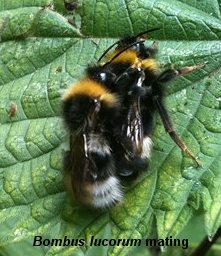
Bombus lucorum mating
The photograph below was sent in by Nurturing Nature, and shows a male and queen Bombus lucorum mating.

Wednesday, 24 November 2010
Bumblebee nest box plans

I've succumbed and made a page of very simple plans for nest boxes using flowerpots and other stuff. It is so sad that people spend a fortune on commercial nest boxes, that often have unsuitable or no nesting materials, then site them in the wrong place and get so disappointed. Even if they do everything right their chances of success are only 25% at best. And this is why I've tried to keep away from this subject. There is no house hunter more picky than a nest searching queen. Her des. res. is dingy tunnel leading to an abandoned mouse/vole nest complete with nesting materials as well as poo and smell of urine. Not a beautifully crafted pine box stinking of glue and pine resin stuck on the end of a pole.
Subscribe to:
Posts (Atom)

 Posts
Posts


